

Owners abroad
The evidence to require from a manager when you live abroad
Reports, photos, authorisations and statements: the concrete evidence that lets an owner living abroad oversee their property in Tangier with confidence.
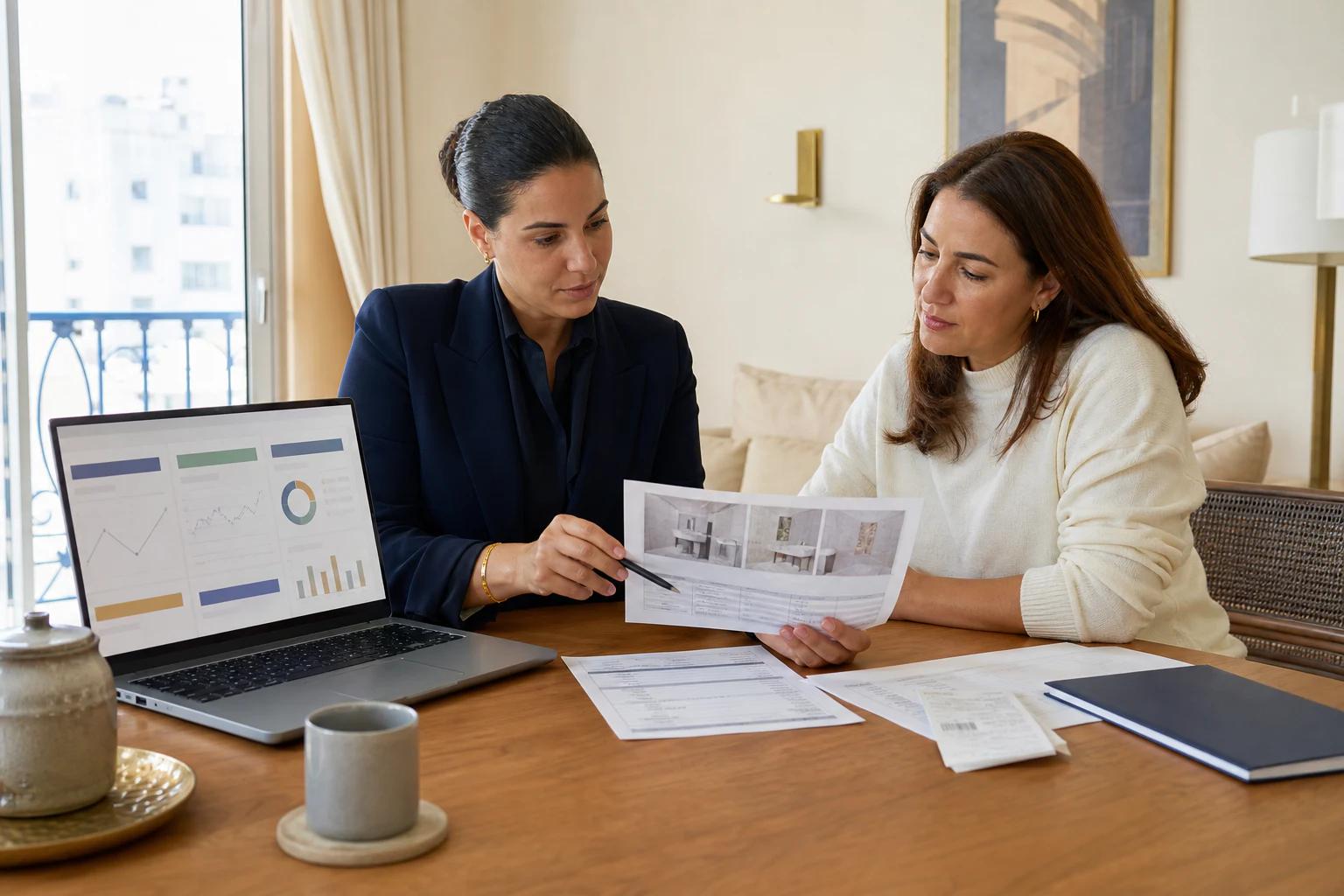
Managing an apartment or a villa in Tangier from Brussels, Paris, Madrid or another city should not force the owner to keep asking for news. Distance becomes difficult when information arrives in scattered messages, with no date, no document and no clearly identified person in charge.
Serious oversight does not depend on the number of messages sent. It depends on regular, understandable evidence linked to the decisions taken. The owner must be able to know what happened, why an expense was incurred, who intervened and what condition the property is in after the work.
Start with a sufficiently precise initial inventory
Before management starts, the owner should receive a clear record of the home. This is not just a list of furniture. Rooms, equipment, meters, keys, access, visible defects and sensitive items must be identified. Dated photos complete this record and create a point of comparison for future visits.
This baseline protects both parties. It avoids blaming a booking for damage that was already there and makes it possible to follow how a piece of equipment ages. For a second home, it also helps organise airing, damp checks, upkeep of the outdoor areas and getting everything running again before the owner arrives.
Ask for a visit report that leads to a decision
A useful report answers simple questions: when did the visit take place, which areas were checked, what anomaly was found, what action is recommended and within what time frame? A series of photos without comment is not enough. Conversely, a long text with no picture does not make it possible to check the visible condition.
The report must separate an observation from an emergency. A bulb to replace, a damp patch and an active leak call for neither the same lead time nor the same authorisation. This classification reduces rushed decisions and lets the owner focus on the issues that really matter.
- Date and identity of the person who carried out the visit.
- Photographs of the areas covered by the mandate.
- Anomalies classified by urgency.
- Proposed action, estimate and expected approval.
- Proof of completion once the repair is finished.
Link every expense to its reason and its receipt
The monthly statement must separate income, platform fees, commission, cleaning, purchases and repairs. A line simply labelled “maintenance” does not give enough information. The owner must be able to open the detail, find the original request and view the invoice or receipt when there is one.
It is also useful to set thresholds. Below an agreed amount, the manager can act to protect the property or restore an essential service. Above it, the owner's approval is requested, except for emergencies provided for in the contract. These rules must be written down before a problem arises.
Follow bookings without logging into several platforms
An owner space can bring Airbnb, Booking and direct bookings together in a single view. The owner sees the occupied dates, the nights booked, the amounts collected and the payouts expected. This summary avoids comparing several calendars by hand or depending on an occasional screenshot.
To stay understandable, the view must distinguish confirmed figures from estimates. A cancellable booking, gross revenue and net income do not represent the same thing. The calculation rules must be visible so that the amount paid out can be matched against the statement.
Choose a single point of contact and a communication rhythm
The owner should not have to contact the cleaner, the plumber and the bookings manager one after the other. A single point of contact centralises the information and remains responsible for closing each issue. Professionals can step in directly, but the follow-up must come back to the same file.
The rhythm must be announced: an immediate notification in an emergency, an update during a major repair and a monthly statement on a fixed date. This organisation builds trust because it reduces uncertainty. It is more useful than round-the-clock availability with no defined response time.
Match the evidence to the signed mandate
The mandate sets out what is included, how often visits take place, the responsibilities, the commissions, the authorised expenses and the termination terms. The reports must make it possible to check this scope. If a monthly visit is planned, its report must be available; if a pool check is not included, it must not be presented as an automatic obligation.
Before signing, the owner can ask for an anonymised example of a report and a statement. They will then understand the level of detail actually provided. Transparency must not be a general promise: it must take the form of documents that can be consulted and cross-checked.
In conclusion
From a distance, trust rests on a visible method: an initial inventory, dated reports, receipts, authorisation rules and regular statements. These elements let the owner keep the final say without having to manage every operational detail.
The Sereni Hosts owner space was designed to bring this information together. The public screens use demonstration data; the real content will depend on the mandate and on the actions actually carried out on the property.
Your property in Tangier
Let’s turn these pointers into an action plan.
A first conversation helps us understand the property, your priorities and the level of support you really need.